
From fundraisers to permanent capital
Rethinking alumnae giving — and why perpetual endowments create more impact than annual donation drives ever will.
Somewhere right now, a chapter’s alumnae development chair is drafting the same email she drafted last spring. The subject line reads something like “Help us reach $18,000 by Founders Day.” The chapter will probably hit the goal. A few dozen alumnae will give $100 or $250. There will be a thank-you post on Instagram. And on July 1st, the balance will be zero — consumed by programming costs, house expenses, and the usual mid-year shortfalls.
Twelve months from now, she’ll do it again.
This is the annual fund loop: a high-effort, recurring campaign that generates real money and zero compounding. It is not a bad thing to run. But for chapters that aspire to genuine long-term financial strength — the kind that funds scholarships for decades, weathers leadership transitions without crisis, and gives future members something the current ones didn’t have — the annual fund alone will never get you there.
Permanent capital will. And the mechanics of how to build it are simpler than most chapters believe.
“The annual fund spends what you raise. An endowment spends what your money earns — and the principal stays forever.”
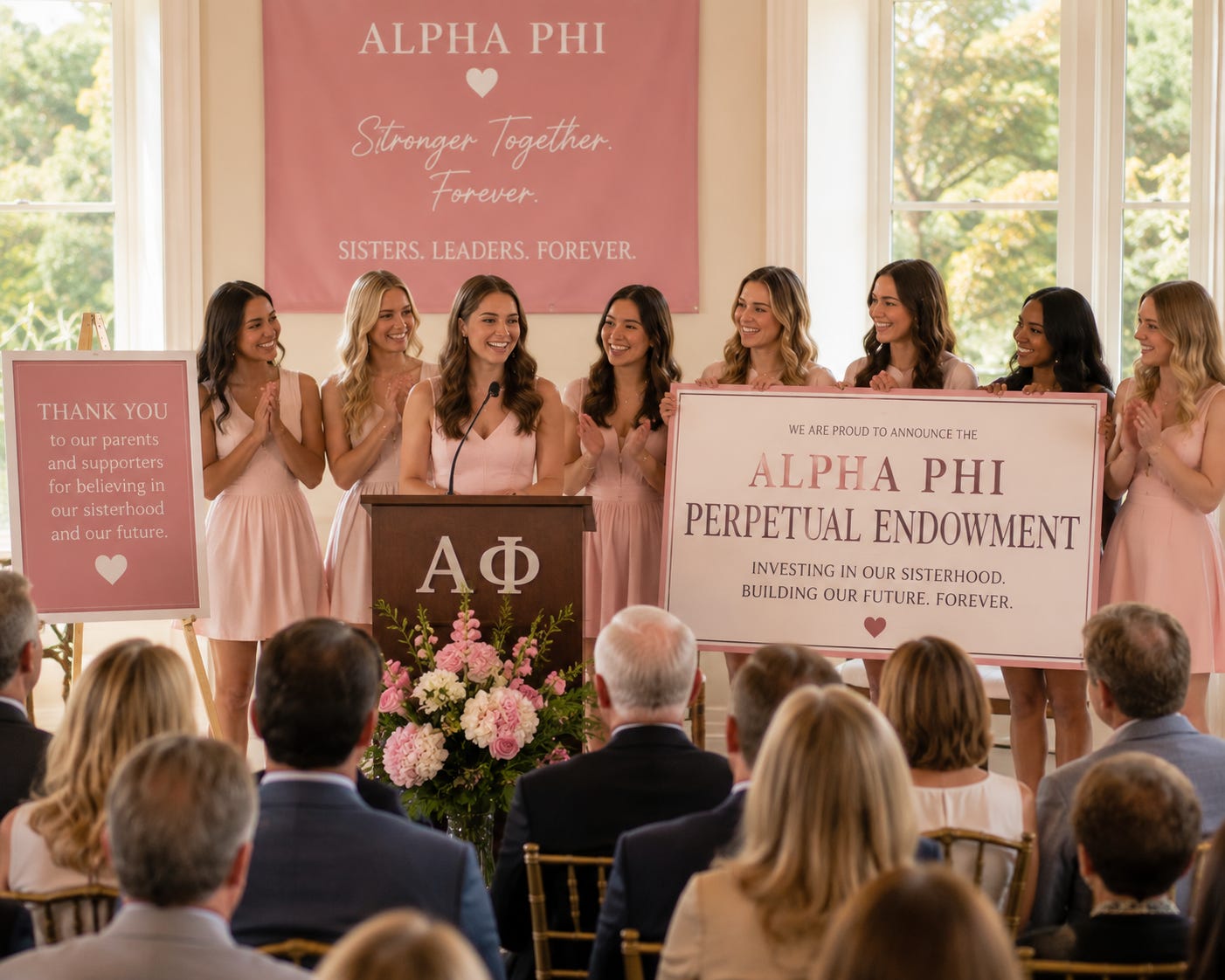
The core distinction: consumable giving vs. permanent capital
Every dollar an alumna gives falls into one of two buckets. Either it gets spent — on a specific program, an operating expense, a renovation project — or it becomes capital: invested, earning returns, and distributing only a portion of those returns each year while the principal grows.
The annual fund is the first bucket. An endowment is the second. The practical difference between them, compounded over time, is staggering.
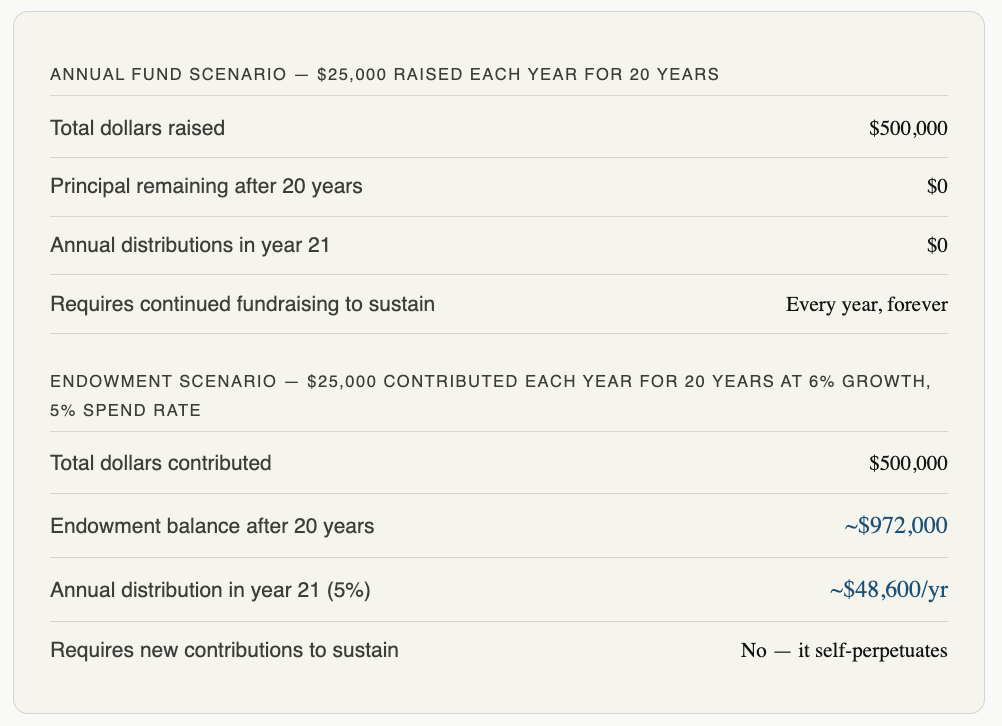
The same dollars. Twenty years of identical contribution behavior. In one scenario, the chapter is back at zero and needs to raise another $25,000 next year. In the other, it has nearly a million dollars working on its behalf and distributes more annually than it ever raised in a single campaign — without asking anyone for anything.
That is the compounding argument for permanent capital. It is not subtle.
Why chapters stay stuck in the annual fund loop
If the math is this clear, why do most chapters never build endowments? The reasons are structural, psychological, and — once identified — largely solvable.
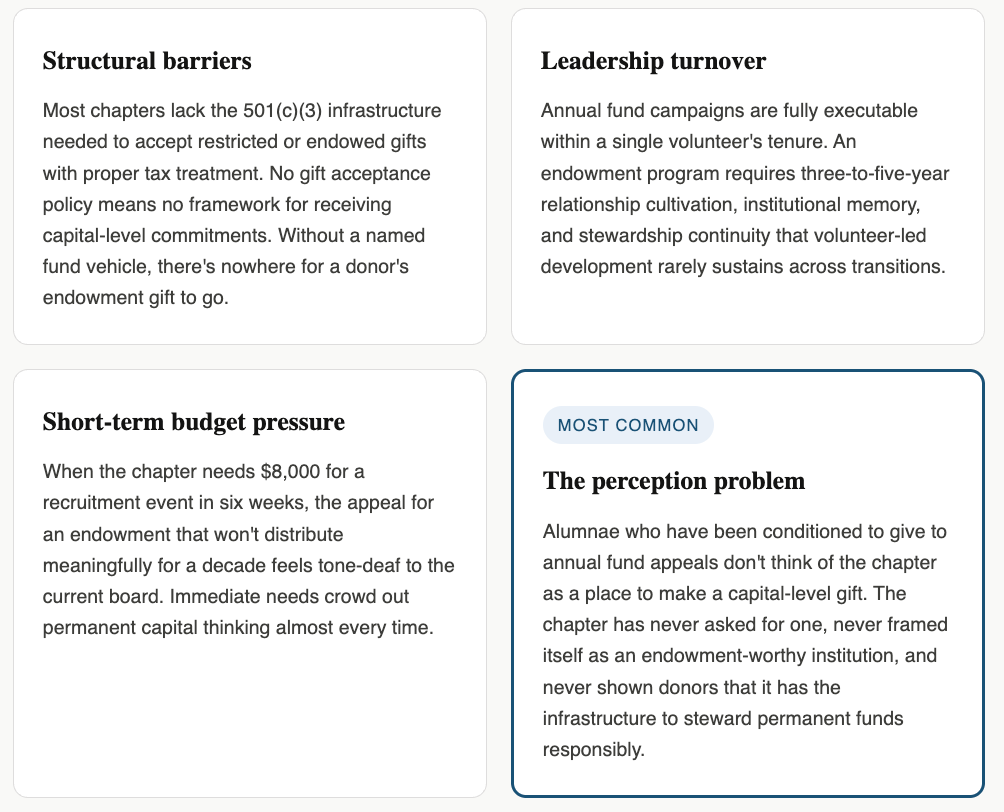
That last barrier — the perception problem — is the most important one, because it is self-reinforcing. Chapters that only ask for annual fund gifts train their donors to only give annual fund gifts. Breaking the loop requires deliberate repositioning.
What a chapter endowment actually is
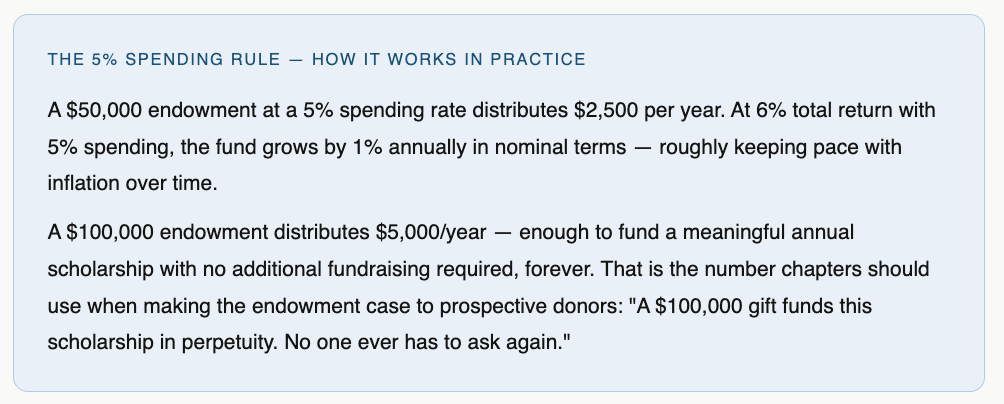
An endowment is a pool of invested capital held in perpetuity, from which a defined annual spending rate — typically 4 to 5% — is distributed for a specific purpose. The principal is never spent. Only the earnings are, and only in part: the remainder is reinvested to maintain the fund’s real purchasing power against inflation.
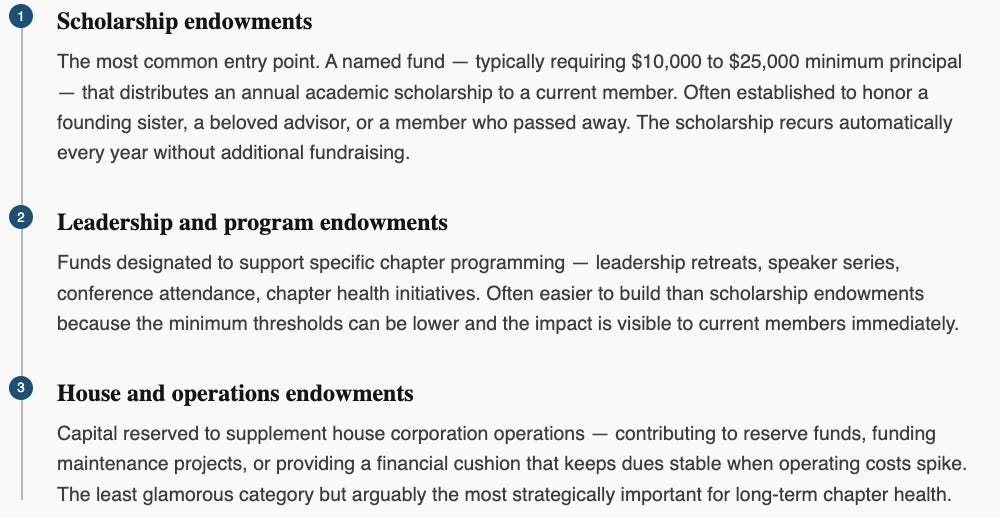
For a sorority chapter, endowment funds typically fall into three categories.
The minimum viable endowment program
Building an endowment program does not require a full-time development director, a seven-figure campaign, or a decade of planning. The minimum viable version has four components, and most chapters can stand one up in a single academic year.
1. A legal home for permanent gifts
Endowed gifts require a 501(c)(3) entity with documented investment and disbursement policy. Most national organizations offer a foundation vehicle — a national educational foundation that can hold chapter-specific named funds. If yours does, that is the fastest path to launch. If not, the chapter’s house corporation can establish its own foundation, typically a $1,500 to $3,000 legal exercise with an attorney familiar with nonprofit formation.
2. A named fund — even just one
The most powerful catalyst for an endowment program is a single named fund with a compelling story behind it. Identify the right honoree — a founding sister, a long-serving house director, a faculty advisor who shaped generations of members — and establish the first fund in her honor. Set a minimum threshold ($15,000 is a common starting point) and invite five to ten alumnae to collectively reach it as founding contributors. The named fund creates proof of concept, social proof, and a replicable template for future funds.
3. An investment policy
Before accepting the first endowment gift, adopt a written investment policy statement specifying asset allocation, rebalancing rules, the spending rate, and who has investment authority. Without policy, every leadership transition creates an opportunity for the fund to be mismanaged or raided. A simple two-page IPS — reviewed by the board annually — is sufficient for a chapter-level endowment in its early years.
4. A stewardship commitment
Endowment donors are long-term institutional partners, not one-time contributors. They should receive an annual report on their fund’s performance and impact — who received the scholarship, what program it funded, what the balance is. A one-page annual fund statement sent every fall, personalized to the named gift, costs almost nothing to produce and is the single most effective retention tool for endowment-level donors.
Repositioning the ask: from annual supporter to permanent investor
The language chapters use to describe giving shapes the level of giving they receive. Annual fund language — “help us reach our goal,” “every gift counts,” “give by June 30” — is transactional. It positions the alumna as a customer purchasing a good feeling, not a partner building something lasting.
Endowment language does something different. It invites the alumna into a different relationship with the institution — one defined by permanence, ownership, and shared purpose across time.
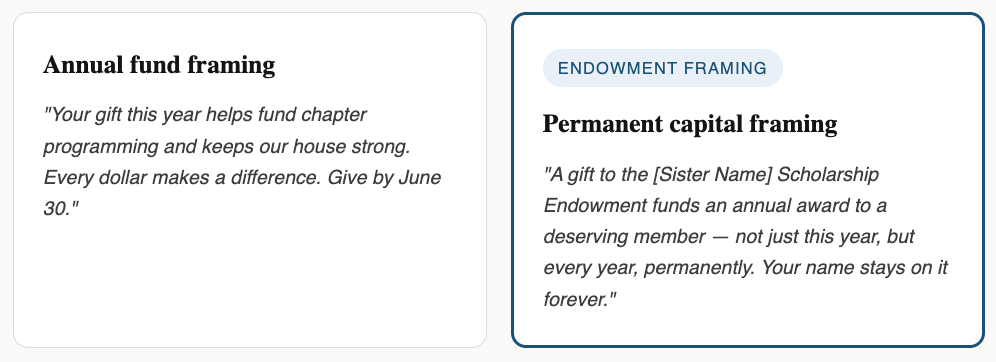
The permanent capital frame answers a different question in the donor’s mind. The annual fund answers: “What does my money do this year?” The endowment answers: “Who does my life stand for, and how does that outlast me?” For alumnae in their peak earning years — 45 to 65, thinking about legacy and meaning — the second question is far more motivating.
“A $1,000 annual fund gift helps the chapter this year. A $20,000 endowment gift helps the chapter every year until the end of time. Which one is more worth asking for?”
Handling the objections
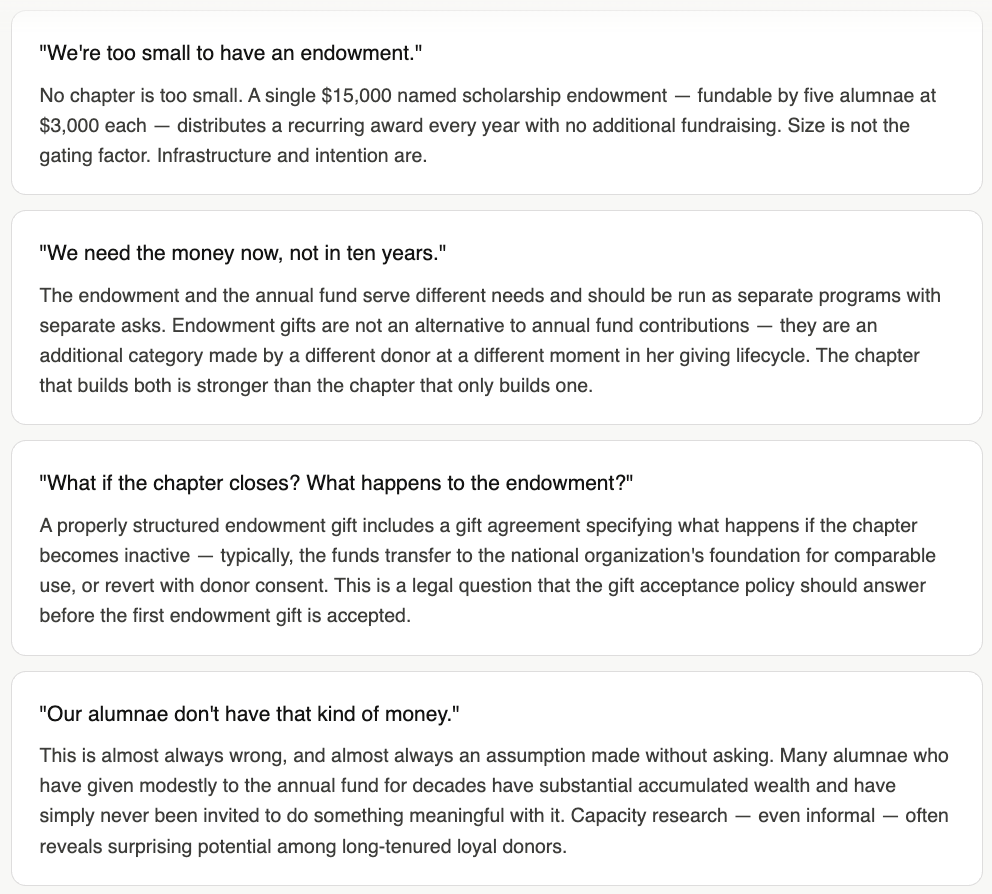
Every endowment conversation encounters resistance. The most common objections are predictable — and answerable.
The transition: running both programs without cannibalizing either
The most common fear about launching an endowment program is that it will pull donations away from the annual fund. In practice, this rarely happens — and when it does, it usually means the endowment program is outperforming expectations.
Segment your donor pool. Annual fund appeals go to all engaged alumnae. Endowment conversations are reserved for high-capacity alumnae who have demonstrated sustained loyalty — typically five or more consecutive annual gifts or a single gift above a defined threshold.
Keep the calendars separate. Annual fund campaigns run on the academic year cycle (fall and spring). Endowment conversations happen year-round, individually, through relationship cultivation — not mass emails.
Make the distinction explicit in donor communications. “The annual fund supports this year’s chapter. The endowment supports every chapter forever.” Said clearly, most high-capacity alumnae will do both — not choose between them.
Assign endowment relationship management to a dedicated volunteer or board member. The endowment development role requires continuity across leadership cycles — it should never be collapsed into the annual fund chair’s responsibilities.
Celebrate endowment milestones publicly. Name each new fund in chapter communications, honor donors at Founders Day, update the endowment total in every annual report. Visibility creates aspiration among alumnae who haven’t yet given at that level.
What permanent capital actually changes
A chapter with a $500,000 endowment is a fundamentally different institution than a chapter without one — not just financially, but organizationally. It has a stable source of annual program funding that doesn’t require a volunteer to beg for it each spring. It has a signal to prospective members and their families that the chapter is a serious institution with long-term staying power. It has a foundation of donor trust — alumnae who made endowment gifts are, by definition, the chapter’s most committed long-term partners.
And it has something subtler but equally important: it has demonstrated to its alumnae that it is worthy of permanent investment. That reputational shift — from “the chapter that needs our help each year” to “the chapter where serious gifts go to work forever” — changes the nature of every development conversation the chapter has going forward.
The annual fundraiser is not going away. Chapters will always need current operating support, and the annual fund remains the best vehicle for it. But the chapters that will be strongest in twenty years are the ones building permanent capital today — one named fund, one endowment gift, one patient relationship at a time.
The loop can be broken. It just requires asking a different question.
Ready to launch your first endowment fund?
Download the Sorority Support Endowment Starter Guide — includes gift acceptance policy template, named fund agreement, IPS framework, and donor conversation scripts.