
The psychology of legacy giving in Greek life
Why alumnae are more likely to give when contributions create permanent institutional impact — and what your chapter can do about it.
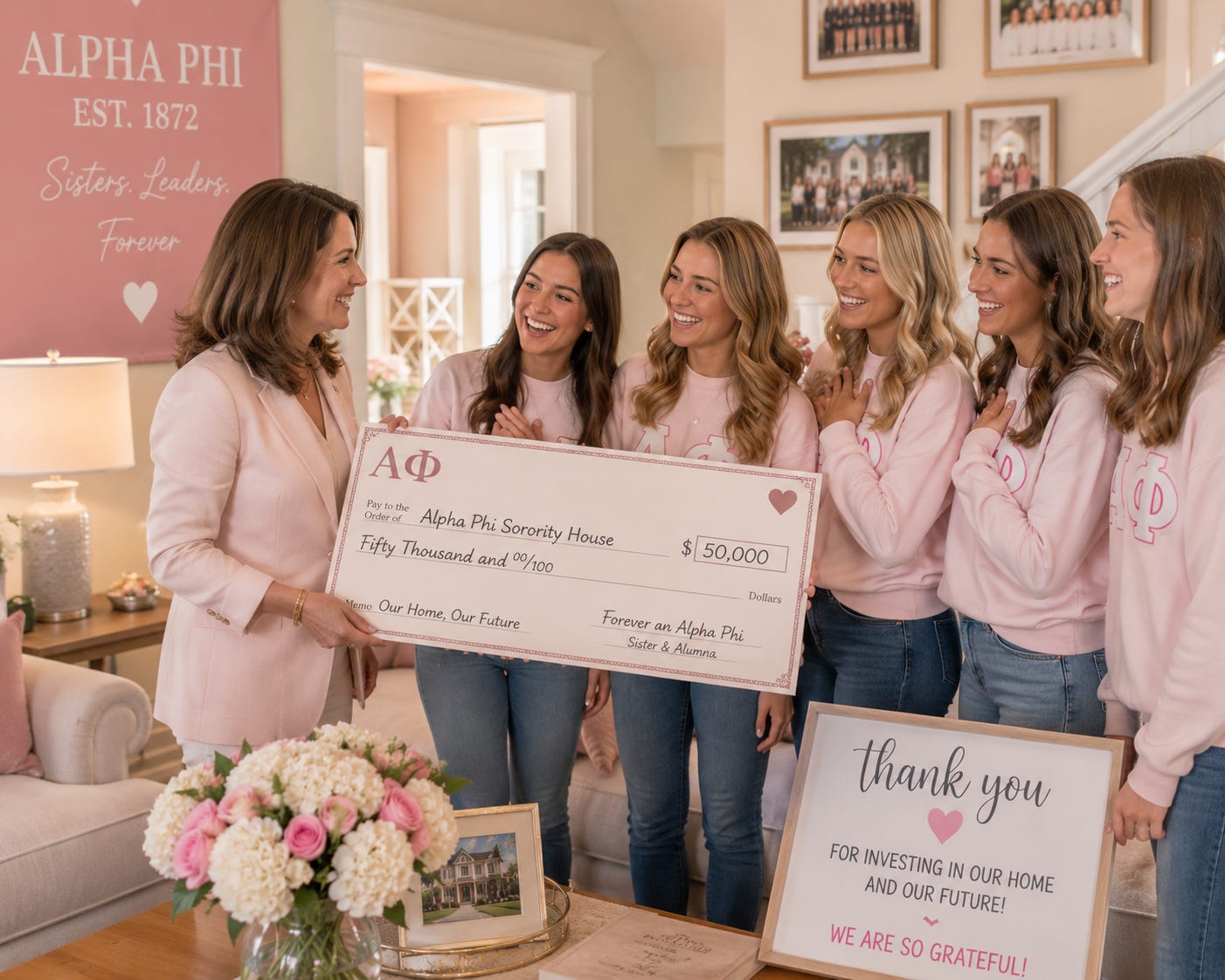
Every development director and house corporation president has heard some version of this story: a devoted alumna who attended every Founders Day for thirty years, who volunteered at every recruitment event, who gushed about her chapter whenever she had the chance — and who never wrote a significant check. Then one year, the chapter broke ground on a new scholarship endowment named in honor of a founding sister. She gave $50,000 within the week.
The gift wasn’t impulsive. The relationship had been building for decades. What changed was the nature of what she was being asked to fund. It wasn’t the annual fund. It wasn’t a new sofa for the chapter room. It was something permanent — something that would carry a name, create a lineage, and outlast her.
Understanding why that dynamic exists — and how to build programs that reliably produce it — is the subject of this article.
“People don’t give to charity. They invest in meaning. The gift is just the transaction; the legacy is the reason.”
The psychology: why permanence changes everything
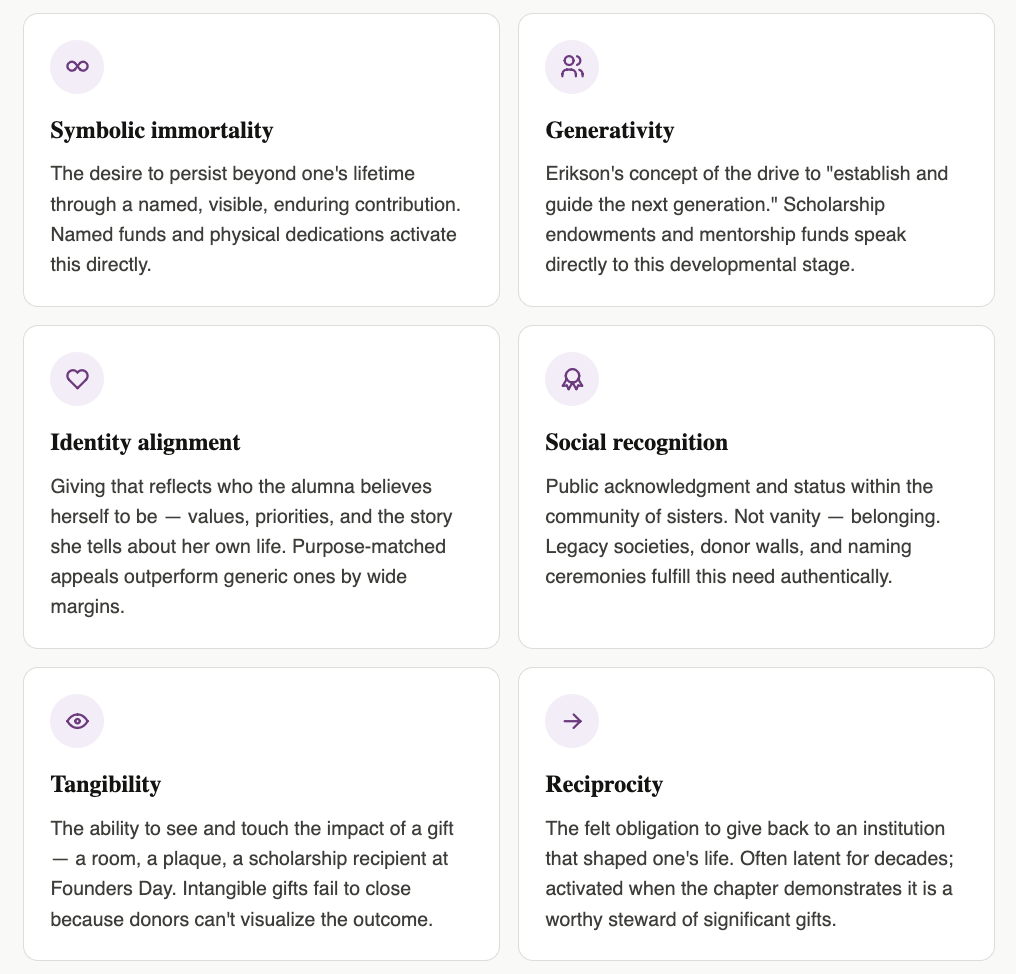
Behavioral philanthropy research has identified a cluster of motivators that separate transactional giving (annual fund, event sponsorships, raffle tickets) from transformational giving — the kind that produces five- and six-figure commitments from people who could afford them for years before they finally made one.
At the center of those motivators is what psychologists call symbolic immortality — the deeply human desire to be remembered, to have mattered, to leave something of yourself behind when you’re gone. Ernest Becker’s foundational work on mortality salience, and subsequent terror management theory research, consistently finds that human beings are wired to seek permanence as a hedge against the anxiety of impermanence. Legacy giving is, at its root, a response to that drive.
For Greek alumnae specifically, this psychological current runs unusually deep. The chapter house is not abstract. It is a physical place where formative years were spent, where lifelong friendships were forged, where identity was shaped. Alumnae don’t give to a chapter because they believe in its current operating budget. They give because they love what the chapter means — and a named scholarship, a renovated chapter room, or an endowed leadership award gives them a way to make that love permanent.
The six psychological drivers of legacy gifts
Why the annual fund leaves money on the table
Annual fund appeals — “Help us reach our goal of $25,000 by June 30th” — are optimized for breadth, not depth. They work fine for generating a wide base of modest donations and for maintaining engagement with alumnae who are in earlier life stages. But they structurally suppress the psychological conditions that produce major gifts.
The annual fund’s implicit message is: your money will be consumed this year. There is no permanence, no naming, no visible impact, no legacy. For an alumna in her 40s or 50s who has accumulated real wealth and is beginning to think about what she wants to leave behind, that message is a mismatch with her giving psychology.
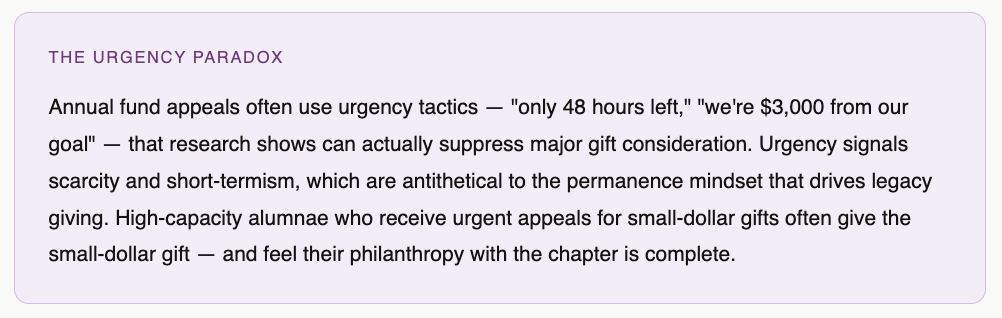
This is not an argument against the annual fund. It’s an argument for running it separately from your major and legacy gift program — with distinct messaging, distinct timelines, and distinct asks that don’t contaminate each other’s psychology.
The giving ladder: how alumnae move toward legacy gifts
Major and legacy gifts rarely arrive without a relationship arc. The path from engaged alumna to transformational donor typically travels through a predictable sequence of stages — and chapters that understand the sequence can design programs that accelerate it.
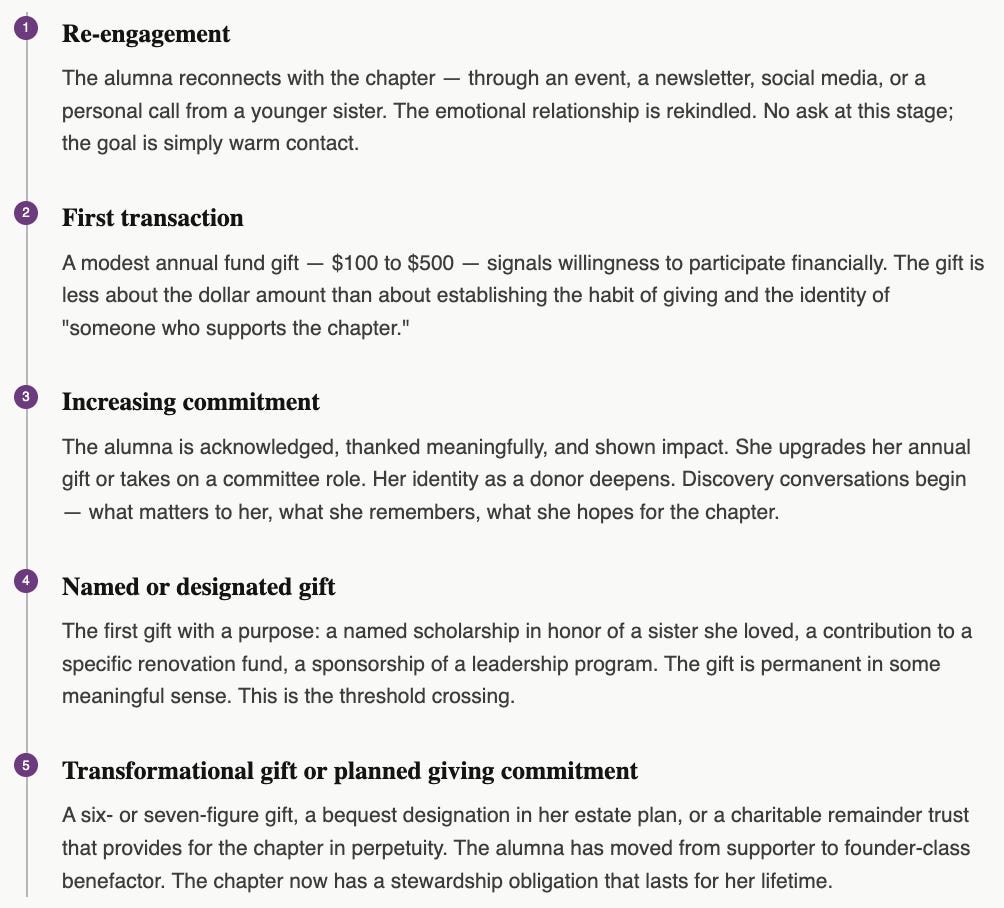
The failure mode chapters most commonly fall into: trying to skip from step one directly to step five. A cold call asking a lapsed alumna for a $100,000 endowment gift is not a major gift strategy — it’s a boundary violation that can permanently damage the relationship.
What makes a gift feel permanent: program design principles
Named funds that endure
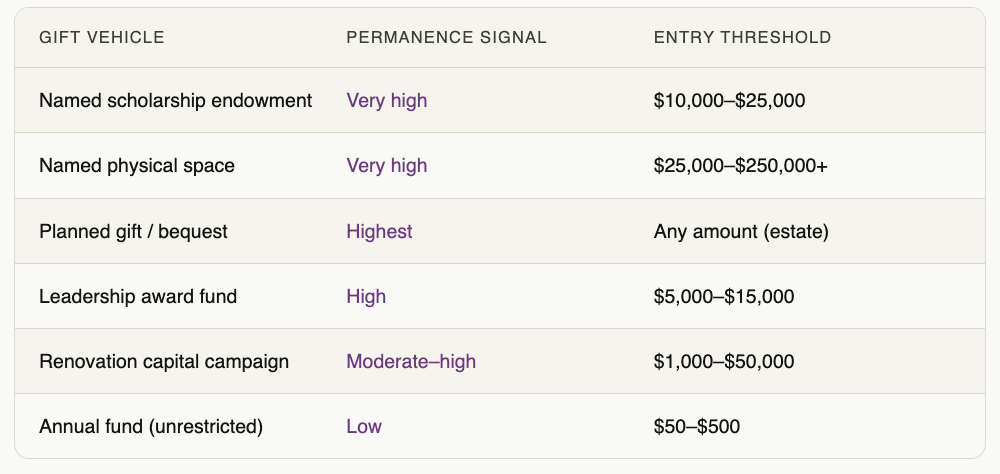
A scholarship endowment requires a minimum principal — typically $10,000 to $25,000 to generate meaningful annual awards — and a clear, permanent name. The name should honor someone meaningful: a founding sister, a beloved advisor, a faculty member who shaped chapter culture. Alumnae who give to establish a named fund are giving to the person being honored as much as to the institution.
Critical: the fund must persist regardless of chapter leadership transitions. It should be held by the house corporation or the national foundation with documented investment and disbursement policy. Funds that disappear when a treasurer changes destroy donor trust permanently.
Physical dedications
Named spaces — a chapter room, a study lounge, a renovated kitchen — produce strong legacy giving because they are visible, permanent, and attach the donor’s name to a place that thousands of future sisters will inhabit. The plaque is not vanity; it is evidence that the gift was real and that the institution has honored its commitment to the donor.
Legacy societies
A formally organized legacy society — with a name, an induction ceremony, an annual gathering, and exclusive recognition — creates social proof that legacy giving is a meaningful identity within the chapter community. Alumnae who might never give a transformational gift in isolation will do so when they see that women they admire have done so before them.
The ask: how to have the conversation
Legacy gift conversations are not transactional. They are relational. The goal of the initial conversation is not to secure a commitment — it is to understand what the alumna cares about and to help her see that the chapter is a vehicle through which she can act on those values.
Lead with gratitude and history, not with the ask. “I’ve been thinking about what the chapter meant to me — what memories stand out for you?” opens the door.
Listen for named people. When an alumna mentions a sister, a housemother, or an advisor who shaped her, that person is often the right honoree for a named gift.
Present specific opportunities, not general needs. “We’re establishing a $15,000 leadership award endowment in honor of founders” is a gift to say yes to. “We need support for the chapter” is not.
Make the permanence vivid. Describe who will benefit, when, and for how long. “Every spring, the recipient will be recognized at Founders Day — and your name will be attached to that moment forever” is a close.
Offer a range without anchoring low. Presenting a giving spectrum from $10,000 to $100,000 signals what significant commitment looks like — without presuming what she can do.
Leave space. Major gift decisions are rarely made in a single conversation. Follow up with a handwritten note and the materials you discussed. Patience is a development strategy.
“The best development officers are not persuaders. They are listeners who help donors find the gift that already fits who they are.”
Building the infrastructure for legacy giving
Legacy giving programs require institutional infrastructure that most chapters have not yet built. The good news: the minimum viable version is simpler than it sounds.
Establish a 501(c)(3) foundation or use your national’s gift-acceptance vehicle. Legacy gifts cannot be made to a house corporation in most structures; donors need a tax-advantaged entity.
Draft a gift acceptance policy. Define what you will and won’t accept (cash, securities, real estate, bequests), at what minimums, and with what naming rights. Without policy, every major gift becomes an improvised negotiation.
Maintain a prospect list — even an informal one — of alumnae with identified capacity and connection. Relationship-building is a multi-year investment; track it.
Create a formal legacy society with a name, an induction process, and an annual moment of recognition. Even a handful of founding members creates social proof for future donors.
Steward existing major donors with intention. Annual impact reports, personal calls from chapter leadership, and invitations to meaningful events signal that the chapter is a worthy long-term partner.
The longer view
Chapters that build serious legacy giving programs don’t do it because they need the money this year. They do it because they understand that the most powerful philanthropic relationship between an alumna and her chapter is built over decades — rooted in identity, activated by meaning, and consummated when the moment and the opportunity finally align.
The alumna who gives $50,000 to name a scholarship doesn’t do it because someone asked her at the right moment. She does it because thirty years of chapter connection have made that gift feel like the most natural expression of who she is. Your job is to make sure the opportunity exists when she’s ready — and that the institution is worthy of the trust she’s placing in it.
That is, ultimately, what legacy giving is: an alumna’s vote of confidence that her chapter will still be worth something long after she’s gone. Honor that confidence, and she’ll tell every sister she knows.
Launch your legacy giving program
Download the Sorority Support Legacy Giving Starter Kit — gift acceptance policy template, legacy society framework, and donor conversation guide.