
Why student leadership should include investment committee experience
Finance governance is as formative as social chair, philanthropy director, or chapter president — and most chapters aren't offering it.
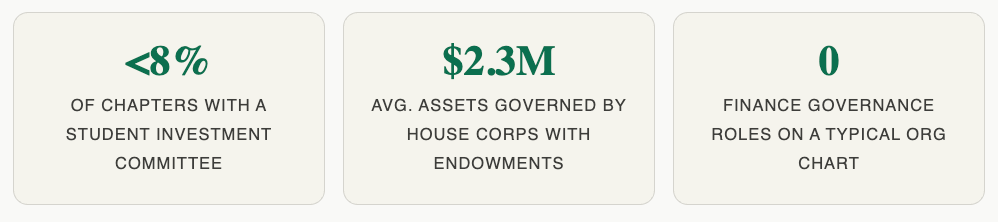
Ask a sorority woman to list the leadership positions in her chapter and she’ll name the same roster every time: president, vice president, treasurer, recruitment chair, philanthropy chair, social chair, panhellenic delegate. These are the roles recognized by national organizations, celebrated in chapter culture, and listed proudly on résumés. They are also, with one partial exception, entirely operations-focused.
The treasurer manages the budget. That is a valuable role. But it is not the same as governing a pool of invested capital — analyzing asset allocation, reviewing investment manager performance, recommending spending policy, and thinking about a fund’s obligations across decades. Almost no chapter offers that experience to its student members. Almost every chapter would benefit from doing so.

Investment committee participation — structured governance of a real financial asset — belongs on the official roster of meaningful sorority leadership. Not as a curiosity for finance majors. As a core leadership development offering, as valuable as any other, and more professionally differentiating than most.
“We teach our members to plan galas, manage volunteers, and lead chapters. We don’t teach them to govern capital. That’s a gap we can close.”
What investment committee work actually involves
An investment committee is a governance body responsible for overseeing the management of invested assets — in this context, a chapter’s reserve fund, endowment, or both. It does not manage money in the day-to-day trading sense. It governs: setting policy, monitoring performance, reviewing allocations, and ensuring that the fund’s investment strategy serves its stated purpose.
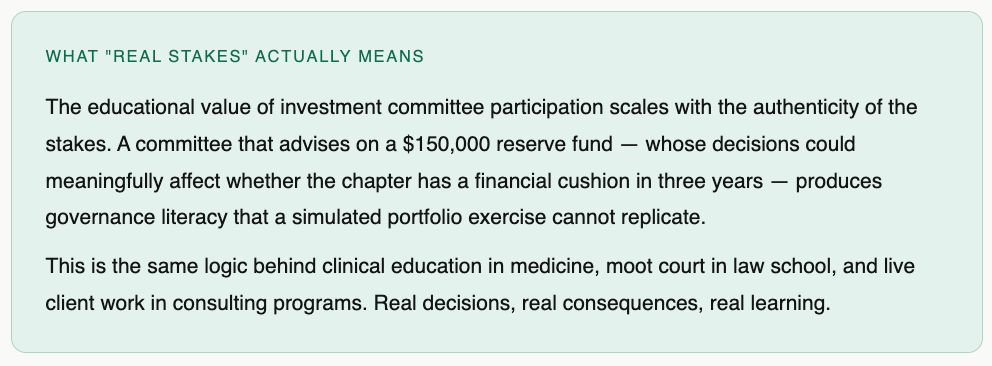
For a chapter with even a modest endowment or a funded reserve, that governance is real work — and real responsibility. The decisions made by an investment committee affect how much money the chapter will have for scholarships in five years, whether the reserve fund can cover a major capital project without a special assessment, and whether the endowment’s purchasing power keeps pace with inflation across generations.
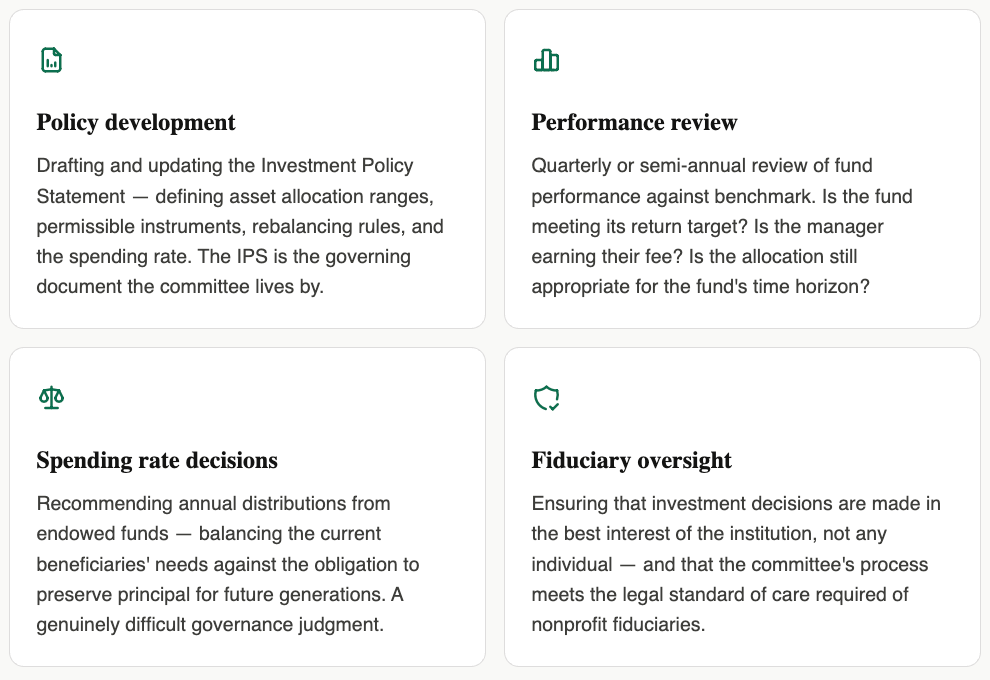
These are not simulated or theoretical tasks. They involve real assets, real legal obligations, and real consequences for real members. That is exactly what makes participation so valuable as a learning experience.
The skills gap no one is talking about
Greek life has always understood that leadership experience is a pipeline — a structured way for members to develop skills, take on responsibility, and build the kind of track record that carries weight after graduation. The organizations that take this seriously produce disproportionate numbers of leaders in every field.
But there is a conspicuous gap in what that pipeline develops. Greek leadership, as currently structured, teaches people to manage people, plan events, coordinate volunteers, raise money through campaigns, and navigate organizational politics. It does not teach people to govern institutions — to think about fiduciary obligation, long-term capital stewardship, investment risk, and the tension between current beneficiaries and future ones.
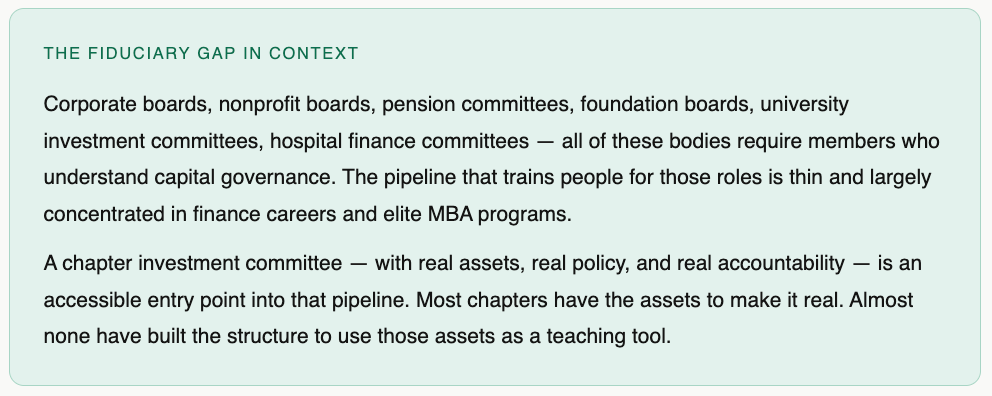
Those are among the most consequential governance skills in any professional context. They are the skills that sit at the board level of every major organization — nonprofit and for-profit alike. And they are almost entirely absent from the leadership development sorority women receive, despite the fact that many chapters are sitting on the exact kind of asset — a reserve fund, a house, an emerging endowment — that would make the practice real.
What investment committee experience teaches that nothing else does
There is a temptation to frame investment committee participation as primarily a finance skill-builder — useful for pre-finance students, irrelevant to everyone else. That framing is wrong, and it’s one of the reasons the idea stalls before it starts. The skills developed through genuine investment governance are broadly applicable and professionally rare in their combination.
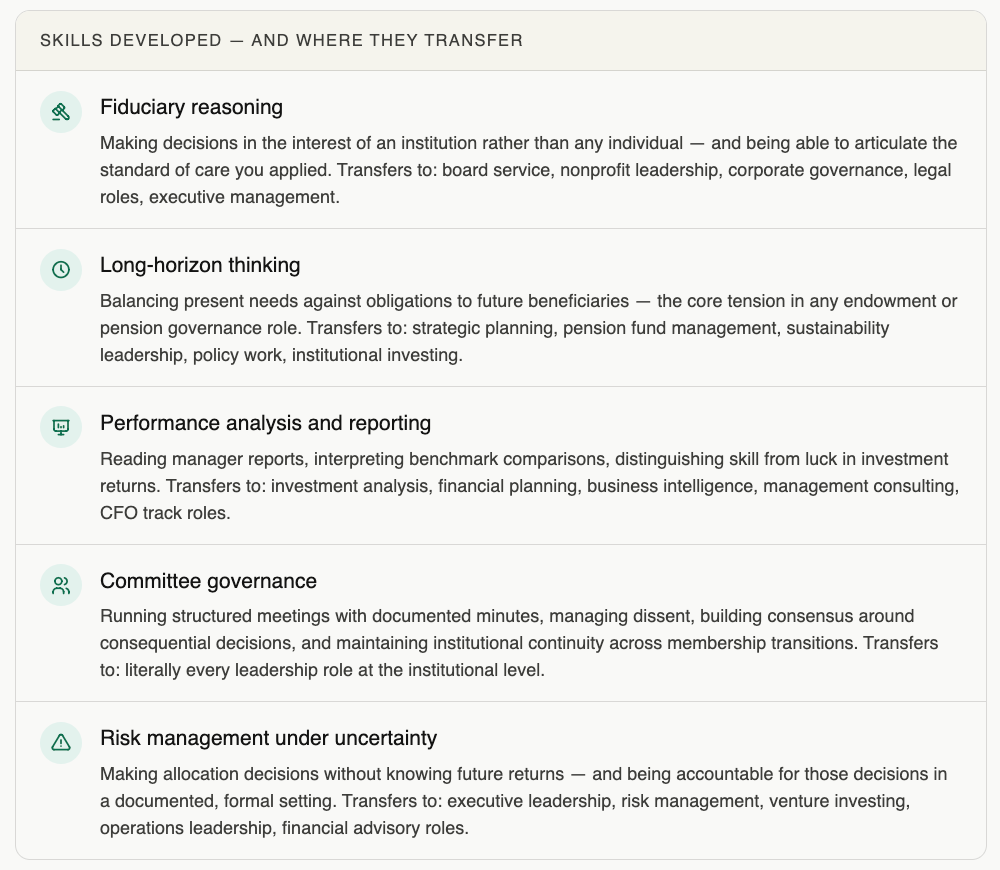
None of these skills require a finance major. They require engagement with a structured governance process and real stakes — both of which a chapter investment committee can provide.
The résumé case: what employers actually see
Leadership roles on a résumé function as signals. “Chapter president” signals organizational management, delegation, and accountability under pressure. “Philanthropy chair” signals community engagement and fundraising competency. “Social chair” signals event execution and stakeholder coordination. These are recognizable signals that translate well.
“Student investment committee member, Chapter Endowment Fund” signals something different — and, for many employers, rarer and more interesting. It signals that the candidate has been trusted with real institutional capital, has operated under fiduciary standards, and has experience in formal governance. That profile is uncommon at the undergraduate level.
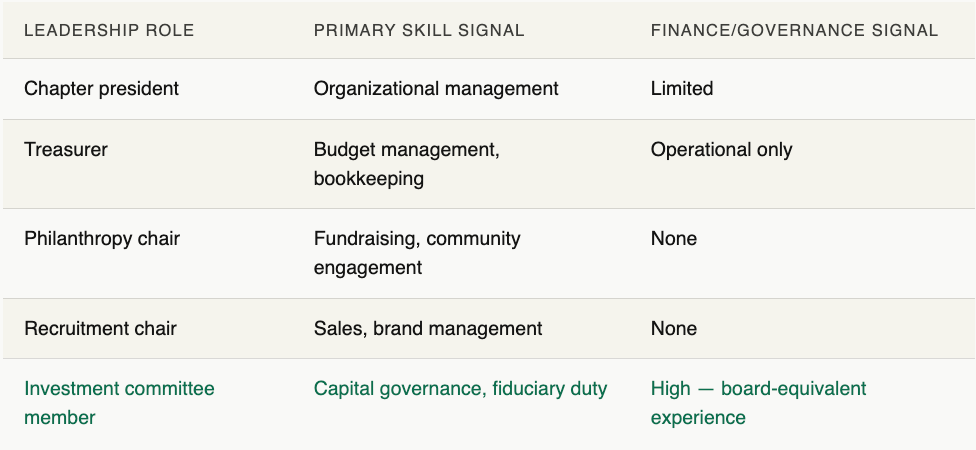
For a junior pursuing a role in investment banking, asset management, consulting, or nonprofit leadership, “investment committee experience” — especially attached to a real fund with real assets — is a differentiating credential that most competitors in the candidate pool cannot claim.
For a junior pursuing any other career, it is still a credible signal of institutional seriousness and governance literacy — qualities that are genuinely rare at the undergraduate level and genuinely valued at the hiring level.
“Every senior candidate can claim ‘leadership experience.’ Almost none can claim fiduciary governance of a real institutional fund. That’s the gap investment committee experience closes.”
How to structure it: a practical model
The most common barrier to launching a student investment committee is uncertainty about what it should look like in practice. The answer is simpler than most chapter advisors expect.
Committee composition
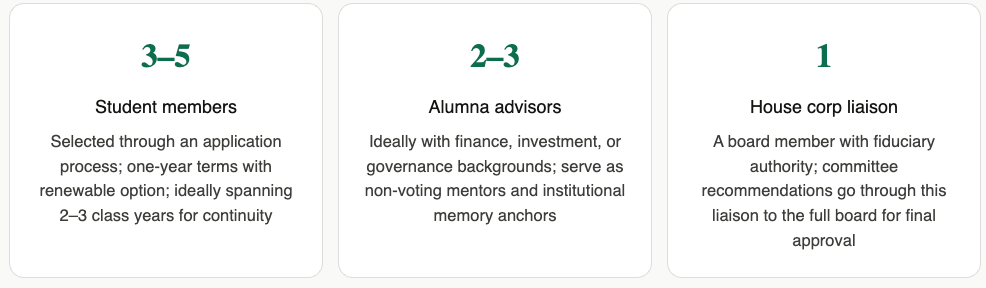
Scope and authority
The student committee should have genuine advisory authority — their recommendations should be formally presented to the house corporation board and taken seriously — but final investment authority should remain with the board’s fiduciaries. This is not a limitation; it is the correct governance structure for any advisory committee, and it mirrors how most real-world investment committees at the sub-board level actually function.
Annual work calendar
Fall semester: review and present on prior year fund performance; benchmark comparison; recommendation on whether current allocation and manager relationships remain appropriate
January: review and recommend annual spending rate for the coming year; prepare endowment distribution memo to the board
Spring semester: IPS review — assess whether the fund’s investment policy remains appropriate; recommend any revisions to asset allocation or spending policy
Year-round: produce quarterly performance reports for the board; participate in structured learning sessions led by alumna advisors on investment concepts, fiduciary standards, and governance practice
Minimum viable asset base
A student investment committee becomes meaningful — rather than purely theoretical — when there is at least one real invested fund to govern. A reserve fund of $75,000 or more, or any endowment fund regardless of size, is sufficient to anchor the committee’s work in real data, real decisions, and real accountability. Chapters with no invested assets can still form a committee in preparation for endowment launch — but the learning deepens dramatically once real capital is involved.
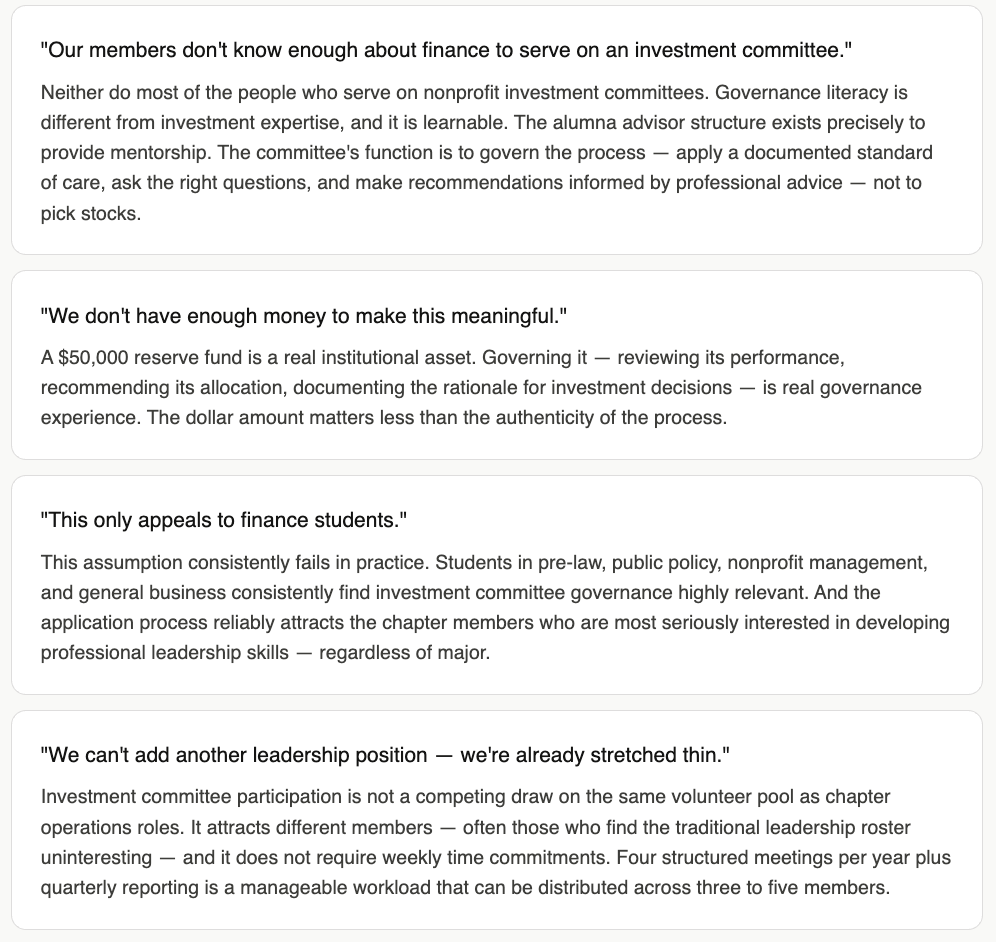
Addressing the objections
The broader argument: what leadership development owes its members
Sorority leadership at its best is a genuine developmental accelerant — a structured environment where young women build skills, take on responsibility, and grow into more capable professionals and community members than they would have become otherwise. That promise is the foundation of Greek life’s value proposition to members, families, and universities.
But a leadership development program that offers no pathway into finance governance — at a time when the chapter is often sitting on a significant institutional asset — is leaving something on the table. It is choosing to develop event planners and volunteer coordinators while forgoing the opportunity to develop institutional governors. Both matter. Both are real skills. Only one is widely available in other collegiate contexts.
The investment committee is not the most glamorous leadership role in the chapter. It will never dominate Bid Day energy or Founders Day programming. But for the women who serve on it — who spend a year learning to think about capital across time, to govern in the interest of members who haven’t yet been initiated, to write a recommendation memo that the board actually acts on — it may be the most professionally consequential leadership experience the chapter offers.
That is worth building. It is also, frankly, worth advertising. The chapter that can honestly say “we develop leaders in finance governance, philanthropy, recruitment, and operations” is offering something meaningfully different from the chapter that offers only the standard roster. In a competitive recruitment environment, that distinction matters.
Launch your chapter investment committee
Download the Sorority Support Investment Committee Starter Kit — committee charter template, IPS framework, sample work calendar, and the application form top chapters use to select members.